
Chorus 5 — What a Haiku Owes
Welcome to Moon and Finger, a feature for addressing and discussing any haiku topic under the sun, in depth, but particularly haiku poetics. The feature is hosted by Orense Nicod and Keith Evetts, and eventually, we hope, by a variety of occasional invited guests. We aim to make it varied and challenging, serious and amusing. Host today is Orense Nicod.

Periodically, Moon and Finger pauses its close readings and essays, not to settle an argument, but to map one. That’s what Chorus is: a running poll of haiku readers and writers, gathering opinion on questions the tradition itself has never fully resolved.
The results are never a verdict. They’re a snapshot of practice, agreement, and disagreement as they actually exist among people who read and write haiku today—a different, and rarer, kind of evidence than any single essay can offer.
Chorus also gives us room the regular issues don’t. It’s where we turn reader questions back to the readership itself: when a question raised through the proposals form seems larger than one exchange can settle, we bring it here and ask what the rest of you think.
You don’t need to have read the Moon and Finger essay to take part. Most Chorus questions aren’t about theory, they’re about practice: how you actually write, read, and judge haiku, whatever your background. If you’ve ever hesitated over whether something counts as a kigo, or wondered whether a poem you loved was “really” a haiku, you already have the experience these polls are asking about.
A snapshot, though, is only as good as its sample, and it’s worth being candid about ours. The gap between what Chorus could show us and what it currently shows us is largely a matter of how many people take a minute to vote. So consider this an open invitation, repeated every issue: if you write haiku, if you only read them, if you’ve never been quite sure where you stand—vote anyway.
The value of Chorus rises directly with the number of people willing to be counted.
What a Haiku Owes
Poll 10 Unfamiliar Words and Poll 15 Shiki and Subjectivity
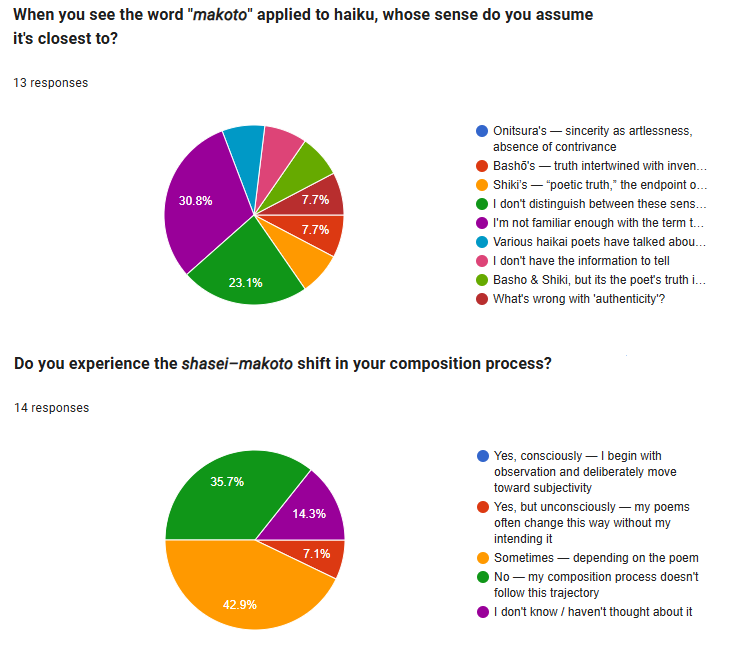
Two polls: 17 responses for poll 10 Unfamiliar Words and 14 responses for Poll 15 on Shiki and Subjectivity. As always these provide indications, not findings and both polls ran alongside essays whose comment threads (87 and 60 comments) say more than a count can.
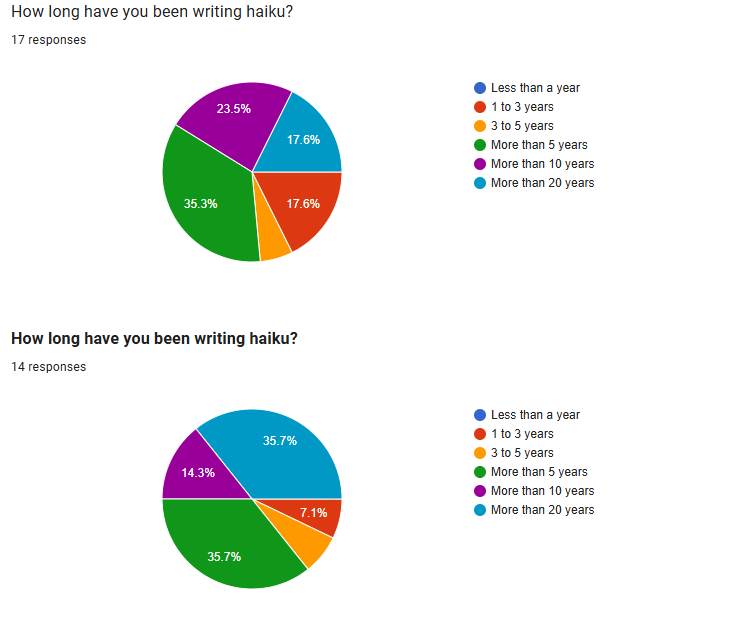
I think both essays and related polls turn on a similar question: what does a haiku owe its reader?
Is it clarity? Particularity? Sincerity? An experience that can be recognised as genuine? And what does it owe the experience from which it was made?
Our two discussions approached these questions from different directions. My essay concerned unfamiliar words and the limits of comprehension; and Adam’s essay was concerned with Shiki, shasei, makoto and the problem of authenticity. Yet both explore a tension between what the poet brings to the poem and what the reader can recover from it. Nothing, neither word nor experience passes unchanged from one person to another. The question is what the poem makes possible despite that distance, or because of it.
The poem answers to itself
Asked who a haiku should be written for, 9 of 17 respondents chose neither the average nor the attentive reader, but “the poem itself”. Asked whether authenticity matters,the answer which recieved the most votes is a haiku only needs to work as a poem, whatever “really” happened (35.7%) .
I think there is a suggestive parallel here. In both discussions, the poem’s own demands seem to take precedence over an external standard: the average reader’s comprehension, or the factual circumstances of the poem’s composition.
But this is not the same as saying that the reader does not matter, or that anything goes. A poem still has to work and what constitutes that success cannot necessarily be decided in advance by a general rule.
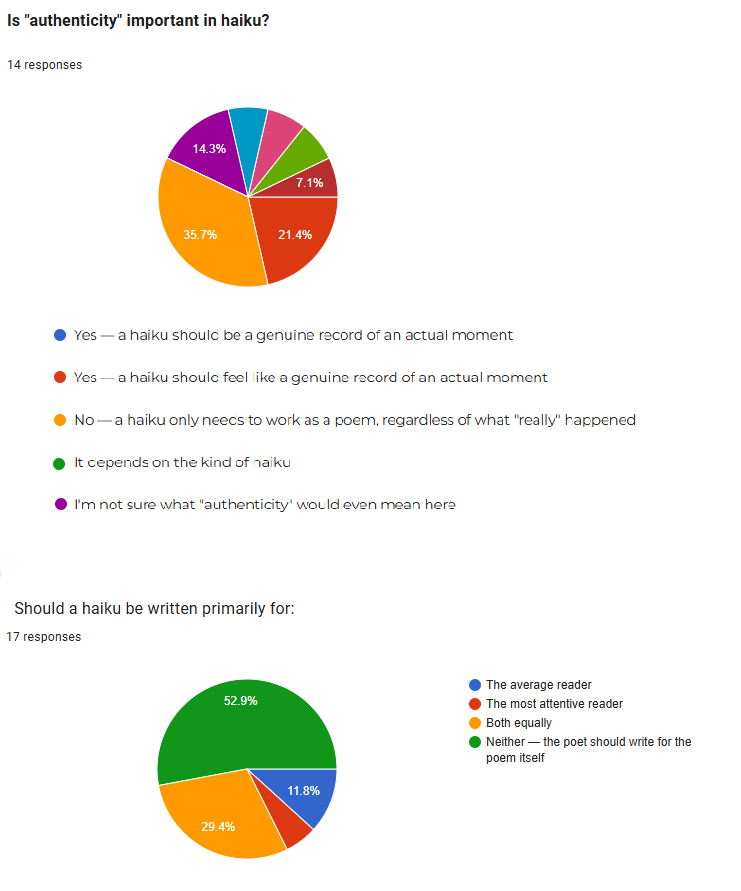
Indeed, the commonest answer in both polls was “it depends on the poem”: 9 of 17 on unfamiliar words, and 8 of 14 on whether shasei describes a starting point or an endpoint. The answer is familiar enough to sound evasive, but the comments show that it often reflects a real difficulty with applying a general criterion to individual poems.
Where does opacity sit?
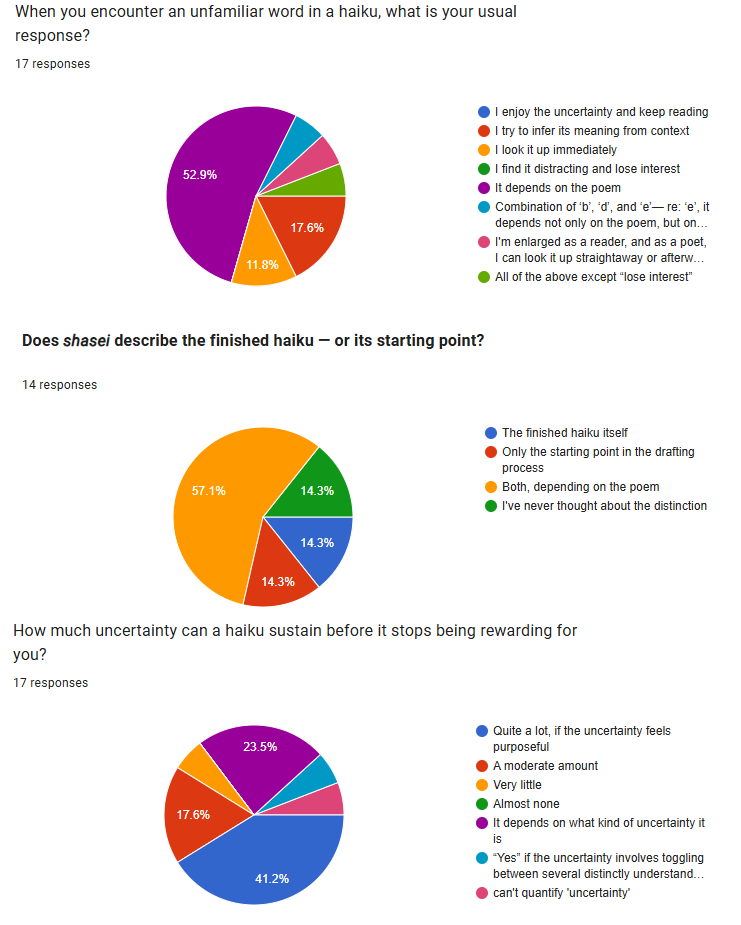
Only 1 of 17 thought a haiku can bear very little uncertainty, and 13 answered in terms of the kind of uncertainty rather than its amount.
The comments on “Meeting a Word” sharpened the point. In the thread I proposed “necessity” as the test: is the word needed, not is it difficult or simple? I later called necessity a condition of the form, not an outside rule. Alan Summers pressed from the other side. He argues that effort is part of literacy, and that poets shouldn’t be pushed towards simplicity. Keith and I answer that effort must be rewarded. Keith’s version: an unfamiliar word needs to earn its effort.
The thread also located opacity in three different places.
In the reader: M. R. Pelletier said the words aren’t opaque and the opacity is in the reader’s mind. I described the gap as a lack of lived experience that no definition fills. Linda Price asked her adult son about a term from a kukai poem and found that it became a shared moment about how the word worked.
In the word’s register: I separated unusual from difficult and opaque. A technical word belongs in a haiku only if its precision is relevant to the situation. SimonJ added that abstract words are more likely to fail than concrete ones.
In the poem’s particularity: John Hamley weighed whether to name Algonquin Park. I argued the name should stay if the particularity serves the experience.
This echoes a poll finding. 10 of 17 had seen a more transparent word weaken a poem, and only 3 said “rarely”. The thread also showed how words wear out. Keith warned that petrichor and murmuration lose impact once they spread, and I argued that a word can be renewed after it becomes a cliché.
The question, then, is not whether the reader should be spared difficulty. It is whether the difficulty belongs to the poem.
An unfamiliar word may be the very thing that gives an experience its particularity. Replacing it with a more accessible word can make the poem easier to enter while making the experience itself less available.
Opacity can be a failure of communication, but it can also be the means by which a poem refuses to flatten what it communicates.
The Hand of History
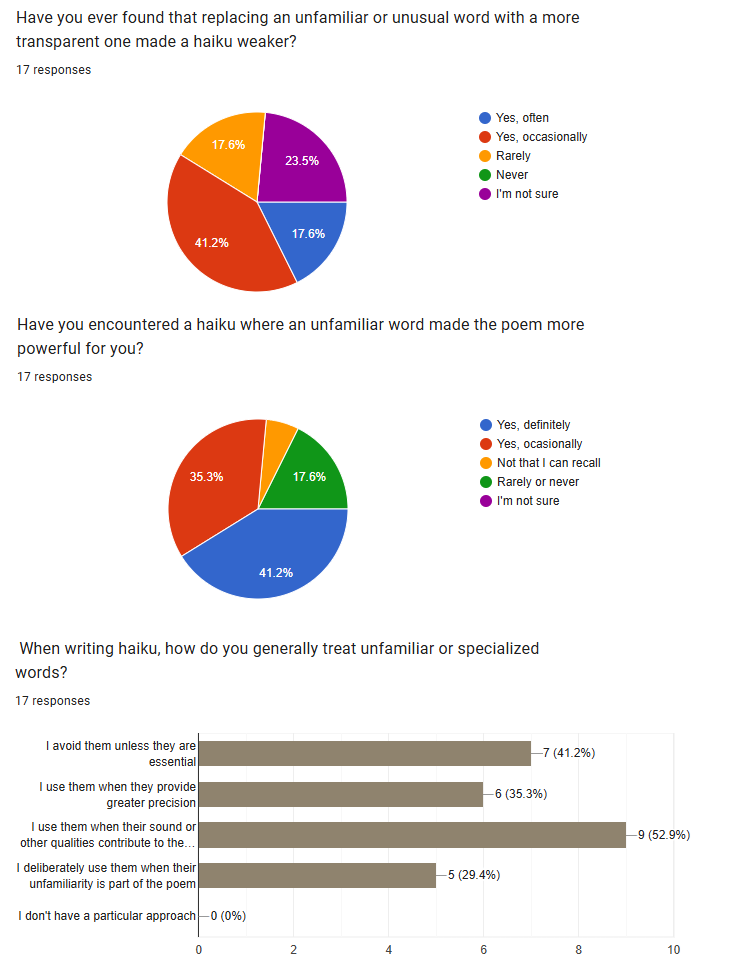
Where does authenticity sit? The poll showed no consensus. 3 respondents wanted a haiku to feel like a genuine record, 5 said it only needs to work as a poem, and 5 more refused or redefined the term. The comments under “Shiki and Subjectivity” supply the positions behind those answers.
Does shasei mean something different today? Only 1 of 14 said yes outright, 5 said the meaning is the same but the implications have changed, and 6 weren’t sure.
The thread is where that middle ground was explored. I asked whether the essay treats subjectivity as a monolith, since variation within an era may exceed variation across eras, and artists often look backward deliberately. Adam answered that no one can step outside their historical subjectivity, so poets always write from it, and that costume-like imitation of the past turns cringeworthy once it is taken as reality. He located the “tyranny” in the “must” imposed by journals and internal pressure.
I replied that subjective proximity is multidimensional: race, gender, class and personal history as well as era. Poems need not reflect their moment to be authentic. Adam’s bell-curve image placed dominant subjectivities at the centre and outliers at the edges, arguing against aiming for the centre while allowing a gradient of authenticity. I then asked whether his claim concerned historicity or subjectivity, and whether his harsh words for “anachronistic” haiku set a standard for individual poems or argued for renewing the tradition. He reframed it as a conditional: if haiku is made from makoto connected to the real, it will look different in each era.
The poll’s middle answers seem to echo that conditional. People simultaneously accept that the world changes and doubt the change reaches the criterion.
The other positions in the thread further complicated the question.
- Authenticity as a poem’s own conditions. I proposed an “encounter-felicity” (a reconstructable situation) and a “literary-felicity” (form and reader uptake), and said a haiku succeeds when the reader completes the cut. I objected to any hierarchy of authenticity, including Shiki’s progression, and suggested poetry transforms subjectivity rather than simply expressing it.
- Inner reality and the “made up”. Peter Yovu argued that pure subjectivity would be rare and abstract, since inner reality needs external correlatives, and that “made up” poems may be rough drafts of something more revealing. Keith countered that dreams can count as real, and that readers bring their own experience to a poem.
- Sincerity. Alan Summers argued that whoever controls the narrative defines makoto, citing Bashō’s fūga no makoto and David Cobb’s “truth of the poet’s heart”. John Hamley values sincerity over cleverness, though he admits the two are hard to tell apart.
- The Forger’s hand. Keith asked whether authenticity matters if a forger’s work is as good, and whether invented verse can succeed. 5 of 14 said, in effect, that it doesn’t matter.
These positions do not resolve authenticity into a single test. They expose several possible objects of fidelity: the external event, the poet’s experience, the historical moment, the truth of the poet’s heart, or the poem’s own internal and literary conditions.
A haiku may be factually accurate without feeling authentic. Another may be invented and nevertheless convey something recognisable and true. The reader cannot necessarily establish the circumstances behind the poem, just as the reader cannot necessarily recover the poet’s intended meaning from an unfamiliar word.
In both cases, the surface does not tell us everything that lies beneath it.
The Distance That Makes the Poem?
Both discussions turn on subjectivity, and both polls suggest that neither accessibility nor authenticity can serve as a sufficient criterion on its own. An unfamiliar word may be necessary even when the reader cannot immediately understand it. A poem may feel sincere even when the reader cannot know whether its circumstances are genuine. In neither case can we simply equate what is accessible with what is true.
But neither can we make difficulty or uncertainty into virtues in themselves. A word must contribute something to the poem; a claim to authenticity must mean more than an unverifiable assertion about the poet’s intentions. The poem has to establish its own conditions of success.
For me, this is where communicability becomes more interesting than transparency. Communication need not mean that the reader receives exactly what the poet experienced, or arrives at exactly the meaning the poet intended. The reader brings a different subjectivity with a different history and a different vocabulary. What the poem can offer is not the original experience intact, but particulars through which another experience may begin.
The poem cannot eliminate the distance between poet and reader. But instead, it can make something of it.
Makoto was unfamiliar ground. 5 of 14 couldn’t say whose sense they assumed yet 7 of 14 report some shift in their own composition. They may be experiencing the process without the term. Perhaps this is another instance of the gap between vocabulary and experience. We may recognise something in our practice without possessing the language to describe it. Conversely, knowing a term does not guarantee that we agree on what it means or how it applies.
In my mind that is one reason the comment threads matter so much. The polls give us a map of responses, but the discussion reveals the distinctions people are trying to make, the assumptions they challenge, and the points at which a question changes shape. The numbers are indications, not verdicts. The comments are not votes, either. They are where the questions become more particular.
A haiku cannot guarantee that its reader will share the poet’s experience, understand every word, or recognise the circumstances behind its composition. But it can offer something more than an assertion that the experience was real or the word was necessary. Perhaps what it owes is simply an encounter: something sufficiently particular, and sufficiently well made, for the reader to take part in it.
And there is another way of approaching the question in the word authentic itself. It comes from the Greek authentēs, meaning one who does things oneself: agency is at its root. The word authenticity points towards the originator, the one whose hand is responsible for what has been made. This complicates the idea that authenticity lies primarily in a poem’s fidelity to the external world. A seemingly objective account may appear authentic because it gives us the world without apparent interference from the poet. Yet that very absence of an identifiable hand may be misleading. What makes a poem “authentic” may be precisely the traces of its maker: the choices, the acts of attention, the selection and shaping through which the world becomes an experience.
This does not mean that subjectivity guarantees authenticity, any more than objectivity guarantees truth. A poem can be contrived or insincere; a faithful record can be deeply affecting. But perhaps we should distinguish between the authenticity of what is represented and that of the person doing the representing. The two may coincide, but they don’t need to. One respondent’s answer to the question of whether authenticity is important in haiku falls on this distinction: yes, in the sense that good art should be, at least in part, an authentic expression of the artist’s subjective reality.
A poem may possess an authenticity of its own, neither reducible to the world it depicts nor to the intentions of its author. It acts on its reader, and its author, through the choices embodied in it, though what those choices make possible depends on the reader’s encounter with them.
So perhaps the question is not simply whether a haiku is authentic, but what, or who, we are asking to be authentic: the world, the poet, or the poem?
Or in other terms, how do we conceive of the haiku poet? As an author, or as an authenticator? And can the poet truly be both?
— Orense Nicod
Questions and Proposals
First we want to thank you for all the suggestions and questions that were submitted through the proposals form.
CALL FOR PROPOSALS:
We’re still collecting haiku for the final instalment of our series on simile, and we’d love your help.
If you come across a haiku that uses simile, please send it our way through the proposals form. It can be your own work or a poem by another poet, preferably one that has been published. Just include the poet’s name and where the haiku was published.
We’re curious to see what is out there, so please don’t worry about deciding whether an example is “good enough” or whether it fits our argument. We look forward to seeing what you find.
If you haven’t taken it already please TAKE THE POLL ABOUT DESIRE LANGUAGE AND HAIKU it has only 9 answers so far.
Discussion is welcomed in the Comments thread at the very end of this post. Meanwhile, if you would like to propose a topic you wish to see addressed, or better still, if you have an outline proposal for an article that you would be prepared to write—if accepted—please submit it to us via the submission form immediately below this text:
Why Moon and Finger? Zen, Chan, and Indian Buddhist texts cite the metaphor of a Finger pointing at the Moon with a caution: do not mistake the finger for the moon itself. Clinging to words or doctrines (the finger) obscures the awakened mind or truth (the moon). Thus, the analyses, views, and critiques of haiku in this feature are but the Finger. Haiku is the Moon itself, to be viewed by all. Views expressed here are those of the individual authors alone, except where otherwise attributed. They are very much open to discussion in the comments thread below. We all learn.
Introducing the hosts:
Orense Nicod is a French poet working across forms, with a particular focus on haiku. Born in Paris, she spent ten years of her childhood in South Africa before returning to France and writes in both French and English.
Her work has appeared in journals including Frogpond, Cattails, and The Asahi Haikuist Network. She has twice won first prize in the Haiku Society of America Rengay Awards, in collaboration with Joan Fingon (2021) and Anton R-kelian (2025).
A former teacher, she is raising her two children and her poetic expectations while co-hosting Moon and Finger with Keith Evetts on The Haiku Foundation.
Keith Evetts lives in Thames Ditton, Surrey. Life Fellow of the Cambridge Philosophical Society. Aside from scientific papers, diplomatic telegrams, and local history articles, he’s written poetry of various kinds for sixty years, much of it sub rosa. Latterly host and managing editor of the Foundation’s re:Virals commentary feature since December 2021, one of the ten editors of the annual Red Moon Anthology, and an administrator of Facebook’s largest haiku group. Married with five children, cottage garden, grey parrot, and a sense of humour. His short bio is here.
Comments: further discussion is invited below. Comments will close when this post is automatically archived.
A note on the comments: Once a discussion reaches more than 20 comments, we’ll use NEW tags🆕️ to make recent activity easier to follow. Keith and I will mark the latest comments so that readers who are following the conversations closely can quickly see where the discussion is currently active.
The tags are not personalized to individual readers; they simply indicate the most recent additions to the discussion. Because we’re doing this manually, there may sometimes be a delay before a new comment is tagged. Depending on how active a discussion is, we’ll generally mark the five most recent comments, and in more active discussions this may extend to the ten most recent.
The NEW tag🆕️ is a navigation aid, not an editorial judgment about the importance or quality of a comment.
THF strives to maintain a safe and friendly environment for our readers and site participants. Participation in our offerings assumes respectful and appropriate behavior of all parties. We reserve the right to refuse service to anyone, for any reason, at any time.
If you see something you feel may violate our Code of Conduct, please report it to the appropriate moderator (the host of this post) or the President here.


“Asked who a haiku should be written for”, I am surprised that “for the poet” would not have been a popular option. Perhaps in some respects this is synonymous with “for the poem itself”, but I think the poet is an important part of the equation. I’ve known haiku poets to advise others not to tailor their poems for particular editors or journals (or indeed for the reader), but to write for “yourself”. Yes, try to make the next poem you write as good as possible (in my terminology, try to achieve the objectives that you have in mind for it), but you can always learn from the process of writing, reviewing and submitting for publication. You can revisit the subject matter again in the future, from a different direction, or with the aid of further life experience. In other forms of artistic expression is it common to write in a particular form only once, or a just few times (opera, film, villanelle), less so in haiku.
Again, apologies if this was covered in previous threads.
Unfortunately I didn’t manage to read the original essays here, but I enjoy your summary of the discussions which followed. I’m perplexed by the use of “owe” applied to haiku. A haiku is an inanimate object (it’s not even an object), surely it cannot “owe” anyone anything. Once written it has an existence only as a collection of words, separate from the person who wrote it. Yes it exists, and I always feel the poet should respect the poem, eg by noting different versions etc. If the poem “fails”, for instance, it is not failing the reader. It is surely the poet who has failed. I always think in terms of objectives: does the poem satisfy the objectives I had in mind when writing it. Only I can decide if it is a success or failure (or something in between), unless someone else knows what I was trying to achieve with it. If it has failed some or all of those initial objectives it is not necessarily a bad poem (it might be a very good poem): this is how one learns and develops. Performing an experiment that fails is not a failure.
Apologies if I have missed the point.
A haiku is an inanimate object (it’s not even an object), surely it cannot “owe” anyone anything. (MG)
“In a way, I suppose, I think of poems as a sort of animal. They have their own life, like animals, by which I mean that they seem quite separate from any person, even from their author, and nothing can be added to them or taken away without maiming and perhaps even killing them. And they have a certain wisdom.
Ted Hughes Poetry in the Making (1967)
“I maintain then that the more form a poem has—I mean living form—the closer it comes to the wild animal.”
Robert Bly
The poem does not owe anyone anything, true. But the poet owes the poem something: to allow it its own life.