
Book of the Week | Gifu-butterfly by Ikuyo Yoshimura
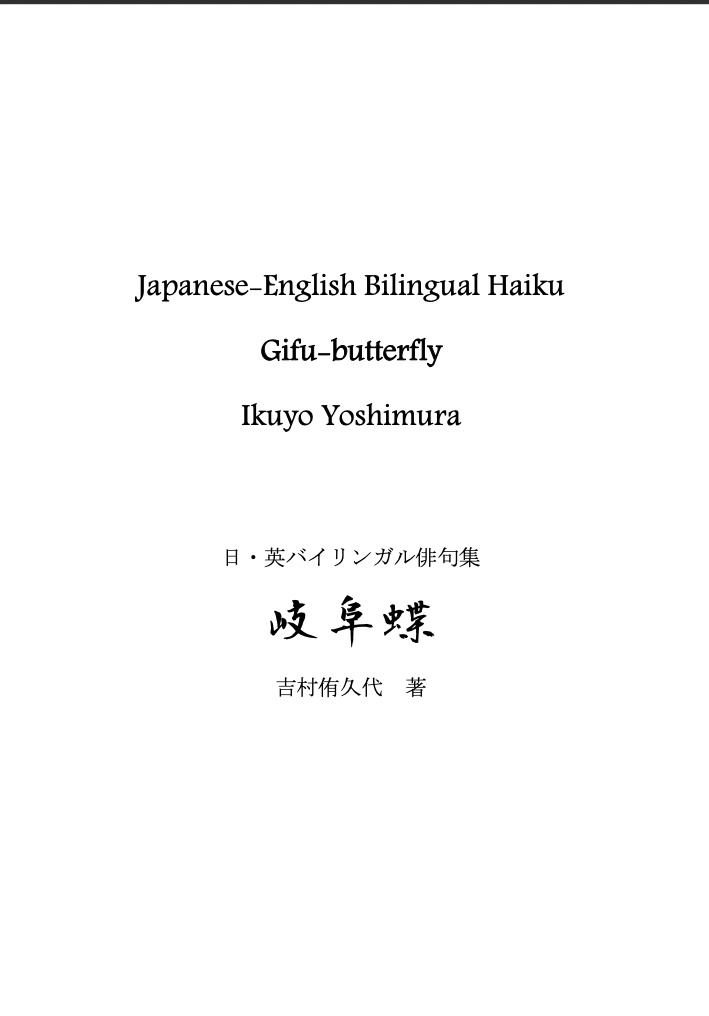
What happens when three different approaches to haiku meet at a single point? In her preface to Gifu-butterfly, Ikuyo Yoshimura describes her practice as a “haiku triangle”. Its three sides are the academic study of R. H. Blyth, the introduction of English-language haiku into college education, and her own composition of haiku in Japanese and English. At the centre of this triangle is the poem itself.
This idea offers a useful way into a collection that is as much about the practice of noticing as it is about the natural world. Yoshimura, a Japanese poet, translator and researcher, has spent decades moving between languages and poetic traditions. She founded the English haiku group Evergreen in 1988 and has worked extensively in both Japanese and English haiku.
The title poem introduces us to a butterfly native to the Gifu region where Yoshimura lives.
a Gifu-butterfly
shaking his wings lightly
first flight
The accompanying note says the butterfly appears when the dog’s-tooth violets bloom. The poet describes it as a messenger announcing spring. The choice of “shaking” is lovely and precise. Rather than giving us the spectacle of flight, the poem catches the moment just before it, when the wings are preparing for departure. (p. 8)
A close attention to everyday experience informs this next poem.
scent of herbs
on the fingertips
spring nearby
The season is not announced by a calendar or a landscape in full bloom. It arrives through touch and smell. In her accompanying note, Yoshimura describes picking fresh sage and mugwort, their sap colouring her fingertips. The poem makes spring’s arrival something the body can register. (p. 9)
Yoshimura is equally alert to unexpected relationships between things.
thunder in the distance
a shrimp jumping up
in the kitchen
The poet explains that she wanted to connect the distant thunder with the small shrimp close at hand, creating a relationship between far and near, large and small. The result is a lively domestic moment in which the kitchen seems to respond to the weather beyond it. (p. 13)
Place and memory come together in another poem.
through bamboo blind
gentle wind touches me
and bows
The note takes us into the traditional Kyoto machiya house where Yoshimura grew up. Its narrow structure and small inner garden were designed to help residents manage the summer heat. The wind passing through the bamboo blind becomes a visitor offering a courteous greeting. A cultural detail becomes a gesture of intimacy. (p. 14)
Family memory takes on a different form here.
Indian summer
everyone becomes a boy
digging the fossils out
Yoshimura writes about her husband’s interest in fossil collecting, a pastime shared first with their children and later with their grandchildren. The poem brings several generations together through one activity. Its “everyone” is important. The years fall away, and the pleasure of discovery belongs to all of them. (p. 18)
The photographs throughout the book add another dimension to this seasonal journey. Each section opens with an image associated with its season. Spring brings flowering trees against a deep blue sky, summer offers a lakeside landscape, autumn features vivid red spider lilies, and winter presents a traditional thatched-roof house framed by autumn-coloured foliage. These photographs establish a sense of place and give the reader a visual passage through the year. The bilingual presentation, with the Japanese poems and their Romanised forms alongside the English translations, also makes the book a valuable encounter with the movement between two languages.
In her preface, Yoshimura writes that haiku is like a snapshot, requiring sharp focus and sensitivity to the sounds of daily life and nature. Gifu-butterfly offers many such snapshots, each shaped by the poet’s attentive engagement with the world.
What small detail in your everyday surroundings tells you that a season is changing?
You can read Gifu-butterfly in the Digital Library.
Do you have a full- or chapbook-length book published in 2021 or earlier that you would like featured as a Book of the Week? Contact us for details. THF Digital Librarian Vidya Premkumar selects Book of the Week titles, and we feature them with permission.

Comments (0)