
re:Virals 579
“More difficult than making your own verses interesting is understanding those of others…” ―Shinkei (1406 –1475). Citing this, Onitsura (1661 – 1738) wrote: “…this should be a way in which a person is completely given over to training.”
Welcome to re:Virals, The Haiku Foundation’s weekly commentary feature on some of your favorites among the best contemporary haiku and senryu written in English. In the host chair today is Keith Evetts. This week’s poem, chosen by Urszula Marciniak is:
the blues
the mirror behind the bar
reflects autumn
Marta Majorka Chociłowska
74th Basho Memorial English Haiku Contest (2020)
Introducing this poem, Urszula writes:
We come to a bar for many reasons — some joyful, others sad. The bartender knows many of our secrets. The mirror sees even more.
Do we have the courage to look into it? Autumn is a good time to confront the past. And perhaps, then, a true spring will arrive.
Host comment (Keith):
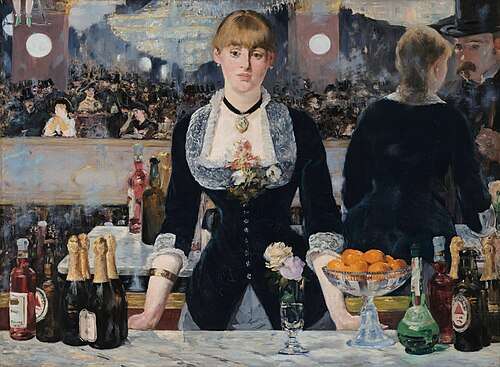
I’m not the only one who sees a painting in this verse. In my case, Manet’s “A Bar at the Folies-Bergère” came immediately to mind, with its Prussian blues, the mirror behind the barmaid, a bowl of harvested oranges on the counter among the bottles, and an autumnal backdrop in the reflected windows:
Blue is consistently named as our favourite colour, associated likewise with carefree blue skies, with the freedom of the oceans, and with sorrow—thanks to Chaucer who first linked blue with tears: “Wyth teres blewe and with a wounded herte” apropos the love affair between Mars and Venus. The blues as a music genre is as widely associated with bars these days as with the ghetto, the hobo and the boxcar. We like putting on our blue denims and savouring this gritty music while quaffing our pints and shots, before returning to comfortable beds in suburbia.
This verse brought back my own experiences as a barman earning a pittance between study grants, and sleeping in the pub attic for some months. Bar counters are often the scene of some lone and late drinker recounting a sob story to the captive barman. I learned a lot.
The four noun elements chosen in this haiku, blues, mirror, bar, and autumn, are all heavy with such associations, harmonised in mood, and it is neatly done without directly introducing the poet. The mirror, however, not only reflects the autumnal mood just as the blues do, but without saying as much suggests that the poet, and now the reader, is also reflected in it.
That there are three uses of the definite article doesn’t bother me at all in this verse. They are all perfectly natural in speech and indicate presence: the blues are these blues, the mirror is this mirror (‘a’ mirror would be weaker). This bar. This moment.
Alan Summers:
The Blues music journey began in West Africa, the first and main enslavement area. The music carried into the Deep South of the United States around the 1860s and 1870s among USA African communities, following the USA Civil War.
It could be said that the music was not just about survival, it was about true grit, and to achieve emotional catharsis, using the blues to get through, and beyond, deep injustices. Globally the blues became the foundational building block for all modern popular music, shaping jazz, rhythm and blues (R&B), rock and roll, rock music, country music, heavy metal, soul and funk, hip-hop, and so much more. All of us outside of Africa owe so much.
The term “the blues” has several meanings from different states of mind, as well as the famous musical genre, and even a uniform. The mental health issue had the blues from a 17th-century English expression “the blue devils,” which originally referred to the intense visual hallucinations or anxiety that accompany severe alcohol withdrawal or delirium tremens. By the 18th and 19th centuries, it shortened to “the blues” to describe general melancholy.
As a uniform it evolved out of post-USA Civil War African-American folk expressions like field hollers, work songs, and spirituals sung by freedmen navigating sharecropping and Jim Crow segregation. In literal or institutional contexts, “the blues” can refer to: Dress Blues: a formal military or police service uniform. Blue Laws: Historical legislation prohibiting certain activities (like selling alcohol or working) on Sundays, a name tied to early American moral codes.
That’s the blues!
There’s a mirror behind the bar where we commiserate with ourselves or even celebrate, and the mirror reflects both us and what lies behind, both the crowded bar, hope of friends arriving or new friend opportunities.
The mirror appears as something that reflects autumn, perhaps the season alone or both the poet in their later years and falling leaves outside, and some gusting through every time the bar’s entrance door lets in new customers. Customers seeking shelter out from the cold evening embrace to a warmer one.
I like the Polish version:
słuchaj to blues
lustro za barem
odbija jesień
It translates back to:
listen, it’s the blues
the mirror behind the bar
reflects the autumn
Hey, it’s the blues, listen, and imbibe, drown your sorrows just enough to fuzz the sharp lines of hurt but not too much.
The repeat action of the definite article of “the” gives us a hidden and coaxing lullaby of ‘the the the’/‘there there there’ and the warming glass of whisky forms a temporary bond back to other sensations of warmth through our lives.
The haiku mirrors myself too.
Ashoka Weerakkody:
At long last, a lovely day! An Autumn haiku brightening it more. By no less a poet than Marta Chocilowska, from Poland, who authored the winning haiku: “funeral / her first journey / alone” in the 16th European Quarterly Kukai, a decade ago, in December 2016, which became a pointer of the way for the likes of me, in Facebook’s Buds of Haiku which she ably administers.
The present verse takes the reader back into the classic surroundings of a melancholic lonely interior which suddenly comes alive in an Autumn’s morning: “the blues / the mirror behind the bar” as the fragment and phrase part here firmly emphasising the permanence of melancholy that has been there, a unique set of things that mark their indelible presence forming the ‘interior decor’ of the period sitting room of the villa the poet enters, with us.
Her use of definitve “the” before “blues”, before “mirror” and before “bar” is the structural base upon which the classic visual image is erected. They are and have been, there for ‘ages,’ hence historic and capital, an asset thereof. They are the “the” things, whilst the third line “reflects autumn” becomes remarkable in that the word “autumn’ hereof doesn’t come with “the” case. It’s likely not solely identifying Autumn the season., since the upper case gives into lower case for some deeper-meant reason. Maybe the poem is all about impermanance in the backdrop of permanence ’cause autumn presented in lower case may mean aging and waning, of the year and inevitably of life itself.
Deeper meanings apart, I was at once attracted to this beautiful view – of the clear pristine blue sky of one ordinary morning in Autumn as it “reflects” off the mirror behind the bar, both articles forming the old times, bleaker times, getting rejuvenated and awakened by the sunshine of the newly dawned day ushering in and lavishly beaming out the happier times! If a haiku can have healing energy, this poem by Marta could well be a fine, smooth distillation!
Finally, as for the aforementioned “funeral…” haiku by the poet, it left a holemark, I trust, of her focus on sadness and melancholy that we need to view with an insight deeper than the emotional component of it but a unique revelation that shall, as I already remarked, heal our sobbing, often painful minds.
Sudha Devi Nayak:
The poet is perhaps trying to escape the blues and cheer herself up with a drink or two at the bar. We don’t know whether this was possible as our sorrows do not completely immerse themselves. “My heart aches and a drowsy numbness pains / My sense as though of hemlock I had drunk” says the English poet John Keats.
Meanwhile as good luck would have it she catches a sliver of the blue sky and the overhanging trees in a blaze of colour, their leaves in tints of orange brown and red sailing down in graceful swirls. Her mood lightens and she looks up in hope.
Autumn is the season of maturity, transition and letting go. After the rejuvenation of spring, the energy of summer, comes autumn with its graces, its turn of leaf, its confusion of colour, just before the stillness and bleakness of winter, teaching us reconciliation with change and transience of all things. Autumn is the time of reflection, introspection and renewal and perhaps the poet gets a flash of all this in the mirror behind the bar and regains her spirit.
Radhamani Sarma:
A wonderful haiku by Marta Chociłowska dealing with life’s implications of introspection, success and failures, sufferings and man’s inevitable surrender to His Will. Marta here begins her haiku of keen observation and perception, with the term, “the blues” preparing our ground for the next step; people with affliction, sadness, inexplicable inward gnawing from any number of personal issues.
The second line, ” the mirror behind the bar,” sounds like proverbial saying, pregnant with layers of meaning. In the bar, the prime purpose of mirror, is safety, reflection, precaution. In our day to day lives, a mirror image is a must, for correcting our perceptions, a multi dimensional view.
The visit of the blues ( suffering and afflicted ) to the bar is for consolation, comfort for the self and forgetting all worries, a kind of soothing panacea. It is not for momentary pleasure.
The last line ” reflects autumn” takes a different twist and turn. The blues, their, misgivings, failures reflect the sad uncertainty of future through the mirror. The mirror is their future blessings, prediction, precaution and care. For all their frequent visits to the bar, drinking, merry making and forgetting their worries, final therapy lies in the “autumn.” Here the haiku writer’s perception lies in the season, something unpredictable, sad in augury…
To conclude, another possible, viable view in the offing, in the autumn (fall) ahead there is a beauty, a change. Perhaps after a total change, the blues are followed by a new life of transformation, a change for better, a new life. A choice mirror image.
Dan Campbell—like a Hopper painting:
The Loneliness in the Mirror
A mirror behind a bar reflects autumn. It’s the kind of scene Edward Hopper might have painted—a familiar place made strangely lonely. Hopper often showed people sitting together yet somehow apart. This poem takes a different approach. There are no people at all, just a mirror catching a glimpse of the changing season.
Picture the bar. A long wooden counter, a few empty stools, bottles lined up on shelves. Behind them, a mirror catches the fading light of an October afternoon.
Nothing unusual. Nothing dramatic.
And yet there’s something sad about it.
A bar is a place where people come to talk, laugh, listen to music, or simply escape being alone for a while. But the poem gives us none of that. No bartender, no customers, no conversations drifting across the room.
There is only the mirror. And what does it reflect? Autumn.
That single word changes everything. Autumn reminds us how quickly life moves along.
There’s something sad about a mirror reflecting autumn instead of a human face. We usually look into mirrors to see ourselves. Here, the mirror shows us the passing year.
And then there’s the first line, “the blues.”
The blues is music born of heartache, longing, and the stubborn determination to keep going. But there’s no music playing in this poem. No harmonica crying out in the darkness. Instead, the mirror tells the story. Autumn supplies the melody.
What I find most moving is that the poem never actually says anyone is lonely or sad. It doesn’t have to.
That’s what makes this poem feel so much like a Hopper painting. It leaves us alone with an ordinary scene and our own memories do the rest.
Author Marta Majorka Chociłowska:
Thank you, Urszula, for selecting my haiku for re:Virals.
This haiku is wrapped in mystery, and I would prefer not to unveil it. Anyone who has read it—or will read it now or in the future—brings their own reflections to the imagery and atmosphere, and I don’t want to impose my perspective.
The fact that it received an honourable mention from a Japanese judge might suggest that themes of ageing and transience are significant here.
I wrote this haiku six years ago in English, though it is not my native language. I was mainly concerned about using the word “the” three times in such a short piece, and I also found it difficult to translate into Polish.

Thanks to all who sent commentaries. As the contributor of the commentary reckoned best this week, Dan has chosen next week’s poem, which you’ll find below. We invite you to write a commentary to it. It may be short, to a maximum of 500 words (succinctness will be valued); academic, your personal response, spontaneous, or idiosyncratic. As long as it focuses on the verse presented, and with respect for the poet, all genuine reader reaction, criticism, and pertinent discussion is of value. Out-takes are kept in the THF Archives. Best of all, the chosen commentary’s author gets to pick the next poem.
Anyone can participate. Simply use the re:Virals commentary form below to enter your commentary on the new week’s poem (“Your text”) by the following Tuesday midnight, Eastern US Time Zone, and then press Submit to send your entry. The Submit button will not be available until Name, Email, and Place of Residence fields are filled in. We look forward to seeing your commentary and finding out about your favourite poems. Please note that commentaries must be your own personal work.
Poem for commentary:
rest area
the cattle truck
filled with eyes
—Tom Clausen
   Upstate Dim Sum 2026:1
Footnote:
Polish haiku poet Marta Majorka Chociłowska is a Founding member of the Polish Haiku Association, and its president since 2018. Editor of Migratory Birds, the Polish Haiku Association’s almanac. She is also a stalwart and active member of The Haiku Foundation, and hosts the Registry of Haiku Poets. Her bio is here, and a selection of her verses in the Living Haiku Anthology here.
—–
In common with other Slavonic languages, although there are several case attributes for nouns, Polish doesn’t have the indefinite and definite articles ‘a’ and ‘the.’ It does have ‘this’ and ‘that’ and the indefinite ‘some’ (thing or person). Instead, it relies on context, word order, and inference. I remember this took some getting used to, along with perfective and imperfective verb pairs. The great thing is, once the complexities are learned it is almost entirely regular—unlike English!
re:Virals is co-hosted by Shawn Blair, Melissa Dennison, Susan Yavaniski, and Keith Evetts (managing editor).
Comments: further discussion is invited below. Comments will close after a week when this post is archived.
THF strives to maintain a safe and friendly environment for our readers and site participants. Participation in our offerings assumes respectful and appropriate behavior of all parties. We reserve the right to refuse service to anyone, for any reason, at any time.
If you see something you feel may violate our Code of Conduct, please report it to the appropriate moderator (the host of this post) or the President here.

Comments (0)