
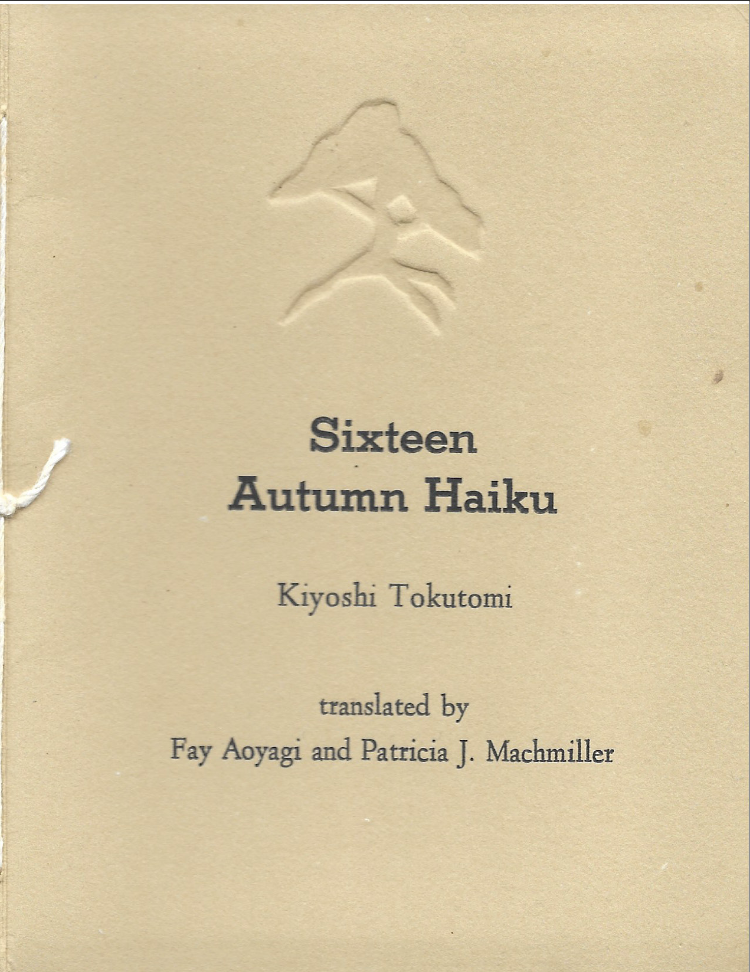
Book of the Week | Sixteen Autumn Haiku by Kiyoshi Tokutomi
“Thirty years / rushing back at once / rice plant chaff”
A return to one’s hometown is rarely just a return to a place. It can be a return to several versions of oneself at once. In Sixteen Autumn Haiku, Kiyoshi Tokutomi revisits Japan after decades away, and the autumn landscape becomes the means through which memory, place and time begin to overlap.
Tokutomi composed these sixteen haiku in Japanese during a visit to Japan from October 19 to November 8, 1983. Fay Aoyagi and Patricia J. Machmiller later translated them. The small 2005 Black Palm Press edition was produced as a hand-set, letterpress book, printed in a limited edition of forty copies.
The collection begins with an act of arrival.
braving autumn rain
the first step into
my homeland
The word “braving” gives the return a physical difficulty. This is not simply a traveller stepping off a train. The rain seems to stand between the poet and the place he has been carrying in memory. That first step therefore becomes both geographical and emotional.
The next poem expands the journey through movement.
Bullet train —
seaside, mountainside, both
in autumn colors
The speed of the shinkansen might seem at odds with haiku’s attention to the moment, yet Tokutomi uses the moving train to gather an entire landscape into one glance. Seaside and mountainside flash past as a single autumn panorama.
There is also a lovely tension between the familiar and the changed in
Red leaves glow —
a modern Rip Van Winkle
returns home
The reference to Urashima, a figure from Japanese legend whose return resembles Rip Van Winkle’s, adds another layer to the homecoming. Tokutomi is not returning to a frozen childhood landscape. Time has moved on without him, and he arrives carrying his own thirty years.
Memory becomes even more intimate in
Autumn night —
my students still have
the faces of long ago
Here the past is not summoned by an old building or a familiar road. It survives in faces. The poem leaves us wondering how much of the remembered people belongs to them and how much belongs to the remembering mind.
Perhaps the most striking return is found in
Loud chorus of insects —
the night of old times
comes back to me now
The insects are present in the immediate moment, but their sound carries the poet backwards. The poem does not need to explain what those earlier nights contained. Sound itself becomes the bridge between two points in a life.
The book is beautifully restrained in its physical presentation. Each haiku occupies its own page, with generous space around the poem and the original Japanese printed beneath the English translation. The result makes reading feel almost like turning through a sequence of small keepsakes. The final colophon tells us that the book was printed by hand in 12 and 14 point type on Rivers BFK Heavyweight and Lightweight paper, a fitting physical setting for poems concerned with returning to things that have endured.
What changes when we return to a place after many years? And what, if anything, remains unchanged enough for us to call it home?
Explore the collection in the Digital Library.
Do you have a full-length or chapbook-length book published in 2021 or earlier that you would like featured as a Book of the Week? Contact us for details. THF Digital Librarian Vidya Premkumar selects Book of the Week titles, and we feature them with permission.

Comments (0)